How do you get on the best-of lists ChatGPT cites? (2026)
20.6% of cited pages were listicle-shaped. How to choose a comparison, brief the publisher, and measure what happened.
Originally published October 7, 2026

Earn a place in a comparison that answers a real buying question. Listicle-shaped pages made up 20.6% of distinct cited pages in our sample. That makes roundups worth inspecting, but it does not establish that adding a brand to one will cause ChatGPT to recommend it.
The listicle study measures page shape and follows a restricted cohort around its first observed citation. It also exposes a useful counterpoint: in the separate naming sample, listicle-shaped page-brand pairs were named less often than pairs on other page shapes. A long comparison can list many brands that the answer leaves out.
Signals runs an aged Reddit account marketplace plus an editorial network for AI brand mentions across Reddit, Quora, Product Hunt, and Threads.
How do we get on a best-of list ChatGPT cites?
Find the comparisons already answering the buyer question, establish why the product belongs, and give the publisher verifiable evidence of that fit. We would start with editorial relevance rather than a promised ranking slot. The publisher needs a defensible reason to include the product, and the reader needs a useful distinction between alternatives.
Choose a specific buying constraint: a team size, integration requirement, budget model, deployment environment, or service need. Then inspect the cited articles and their inclusion criteria. A product can be credible without fitting every comparison. Forcing it into the wrong list makes both the article and the brand's pitch less useful.
Prepare the supporting facts before outreach. Include official documentation, current availability, and limitations. If the publisher needs hands-on evaluation, provide an appropriate way to do that without dictating the verdict. A list that tests a real claim is a stronger editorial target than one that accepts every paying product without explanation.
What did the cited-page sample show?
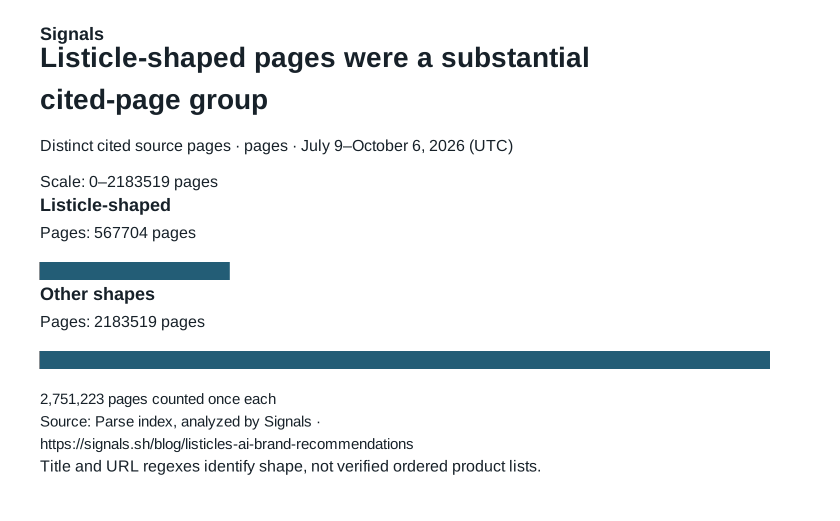
We classified 567,704 of 2,751,223 distinct cited pages as listicle-shaped using their titles and URLs. That is 20.6% of the measured page set from July 9 through October 6, 2026. The counting rule gives each page one vote, so repeatedly cited pages do not dominate this particular share.
The classifier looks for best-of, top-list, and roundup wording. It does not read every article or verify that every matching page is a ranked product comparison. A tutorial with “best” in its title can enter the group, while a comparison with different wording can be missed. The study publishes the exact rule.
Use the result as evidence that this page shape is common enough to investigate. Do not turn it into a claim that the same share of all web pages are lists, or that a newly published roundup has that chance of being cited. Both statements would require a different denominator.
Does inclusion mean the answer will name the brand?
No reliable naming promise follows from inclusion. In the separate measured page-brand-answer sample, listicle-shaped pairs had a 27.94% naming rate, compared with 39.03% on other page shapes. The difference is observational, and the denominator includes every detected brand on a cited page, not only the brands selected by the answer.
A broad roundup can contain many alternatives while the engine names only those that fit the question. That makes the denominator larger without making the article useless. The comparison also mixes topics, publishers, brands, and mention prominence. It is not an experiment assigning the same product to different article formats.
For the brief, focus on the product's relevant use case and the evidence supporting it. Ask the publisher to explain who should choose it and who should choose something else. The brand-naming study supplies the engine and prominence splits behind this comparison, with their own sample sizes.
Should we pay for a higher position in the list?
This batch does not establish that a higher list position causes a higher recommendation position in an AI answer. We did not extract the order of products from every article and compare it with answer order. A vendor selling a premium slot should explain its reader value without presenting that unmeasured relationship as a research finding.
Inspect how the list is organized. Some comparisons use numbered rankings; others use categories such as best for a particular workflow. A product placed lower in a broad ranking might still be the relevant choice for a narrow question. The label and explanation matter alongside the visual position.
Ask what the publisher's ordering means and whether commercial terms affect it. Preserve disclosure and editorial criteria. We would rather have an accurate, useful treatment for the right buyer than a prominent slot that misrepresents the product. That is an editorial decision rule, not an estimated effect from the citation sample.
When does a roundup opportunity work, and when does it fail?
The opportunity fits when the product satisfies the article's criteria and can add a meaningful alternative for the reader. It fails when the buyer is asked to purchase inclusion before seeing the host, topic, or proposed treatment. We evaluate the actual comparison because a placement category alone does not specify the work being delivered.
Use this table while reviewing candidate articles:
| Element | Works when | Fails when |
|---|---|---|
| Topic | The list matches a genuine use case | The product is outside the category |
| Criteria | Inclusion has a defensible basis | Every advertiser receives the same praise |
| Evidence | Claims are documented or tested | The writer invents experience |
| Maintenance | Product facts can be corrected | The placement has no correction process |
The acceptance rule applies whether outreach is handled internally or by a vendor. A page can meet it and still never appear in the monitored answers. Publication quality and observed AI naming remain separate checkpoints.
How should we shortlist publishers?
Collect the specific URLs cited for the chosen buyer questions, then inspect their editorial fit and current accuracy. A domain's overall visibility can help with discovery, but the proposed page must answer the right question. We would reject an irrelevant topic even when the same publisher has highly cited articles in another category.
Read how the publication handles comparisons. Check whether it describes testing, identifies limitations, updates stale facts, and distinguishes commercial relationships. Those details help determine whether the product can be represented honestly. Save the article URL and the dated answer that led to it so the shortlist can be reviewed later.
For a new article, ask why the host's readers need it and how it differs from existing coverage. Publishing another thin list is not the same deliverable as adding a useful product evaluation. The research sample describes pages already cited; it cannot guarantee that a newly commissioned page inherits another article's visibility.
What should the vendor and editorial brief specify?
Specify the host, proposed topic, intended reader, inclusion criteria, and factual treatment of the product. Ask whether the work updates an existing article or creates a new one. That difference changes the baseline, the proof of delivery, and what a later observation can reasonably be compared with in the campaign record.
Provide the canonical brand name, official product references, supported features, pricing source if relevant, and limitations. Request the proposed description and disclosure before publication. State what evidence the writer needs for any testing claim and what happens if the product does not meet the article's stated criteria.
The delivery packet should include the final URL, publication or update date, final text, and a correction process. Set a schedule for the editorial work rather than promising an AI outcome. If the offer includes a particular placement position, clarify its meaning and commercial basis. Do not treat that slot as a measured recommendation-ranking guarantee.
How long until a listicle gets cited?
We cannot estimate publication-to-citation lag from this batch. The entry analysis uses the date Parse first observed a page being cited, which can be much later than publication. It also selects pages that appeared again in the later observation panel, so it cannot represent the full population of newly published roundups.
That distinction prevents a tempting but invalid interpretation. A rise in brand naming after first observed citation would not show that publication caused the rise or tell a buyer how long to wait. The page might have existed earlier, other coverage might have changed, or the engine might have changed its answer behavior.
For new work, save the real publication or edit timestamp and track a fixed question panel. Record first observed citation separately. A scheduled review is useful project management, but this study cannot supply a guaranteed waiting period. Keep the missing lag estimate visible instead of filling it with an industry rule of thumb.
How should we measure the placement afterward?
Compare the same buyer questions on the same engines before and after the work, preserving the sources and answer wording. For an existing roundup, record what changed in the article as well as when it changed. That lets the team distinguish a new brand inclusion from a general page refresh or an unrelated source change.
The AI visibility guide helps define the question panel. The listicle study explains our retrospective entry cohort and why its before-and-after comparison is not a service-effect estimate. Use those limits when presenting the campaign, especially if other marketing work happened during the same period.
Record whether the brand was named, how it was described, and whether the target article was cited. A favorable mention with another source is still an observed outcome, but it should not be assigned automatically to the placement. Report the evidence first and reserve causal language for a design that can support it.
Questions operators ask about best-of lists
The common questions concern inclusion, ranking, and timing. The measured evidence supports investigating relevant comparison pages and checking the actual answer after publication. It does not justify a guaranteed slot-to-recommendation formula. We use that distinction to keep an editorial brief concrete while avoiding a result the publisher or placement vendor cannot substantiate.
How do we get cited by ChatGPT?
Start with a specific buyer question and inspect its sources. For roundup outreach, supply verifiable evidence that the product belongs in the comparison. Citation is not guaranteed.
Do best-of lists help AI visibility?
They are present in the measured citation set. That observation does not estimate the effect of adding a product to a list or publishing a new roundup.
Does being first on a list make ChatGPT recommend us first?
This batch did not measure article order against answer order. Do not use its page-shape results as evidence for that claim.