Directory listings for AI search: which directories get cited? (2026)
Directories supplied 2.7% of measured citations. Choose relevant hosts, specify the listing, and verify the public result.
Originally published October 7, 2026

Choose directories by the buyer question they help answer, not by the length of a submission list. Directories and review sites supplied 2.7% of measured citations in our sample. The useful next step is to identify which of those sites matters for your market and whether its listing contains accurate, decision-ready information.
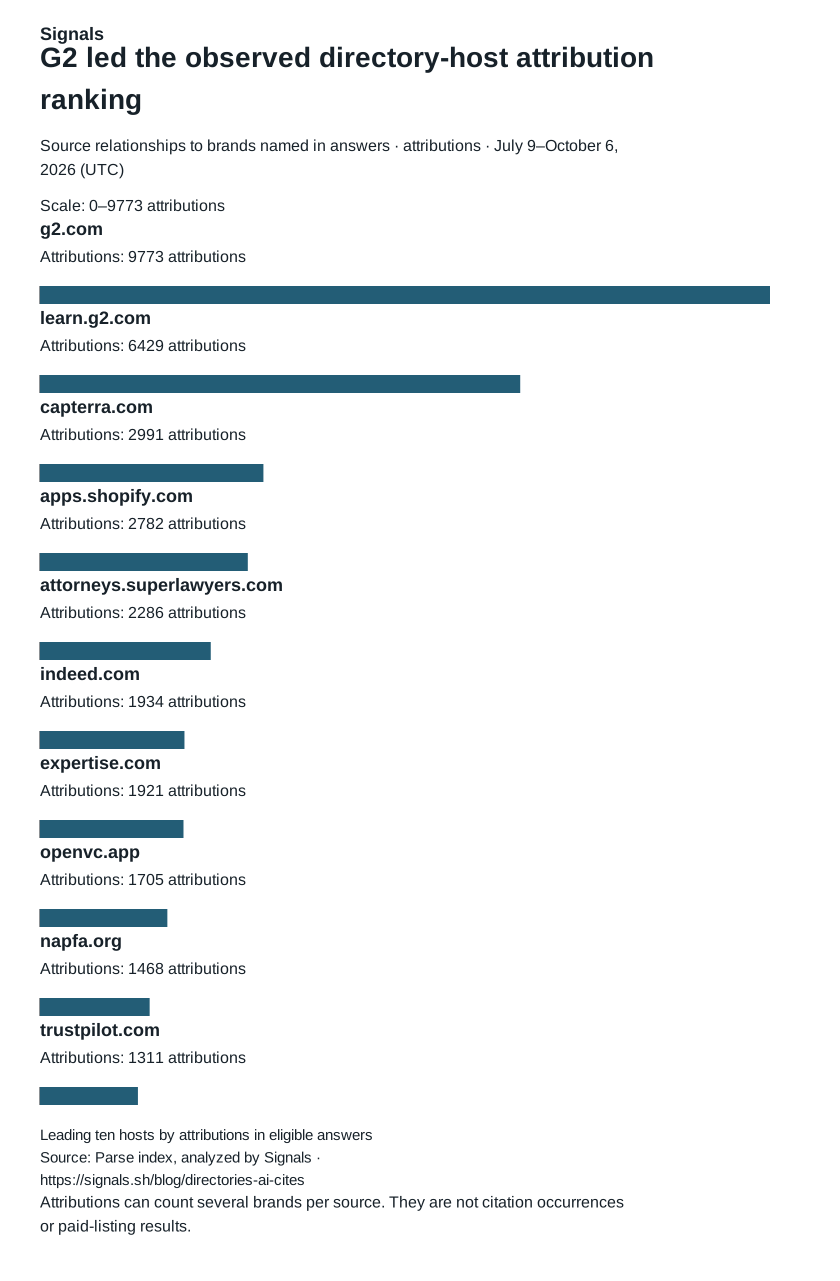
The directory study ranks hosts by brand attributions: links between a cited page and a brand named in the answer. That is a stronger starting point than counting available listing sites, although it still does not establish the benefit of buying a listing.
Signals runs an aged Reddit account marketplace plus an editorial network for AI brand mentions across Reddit, Quora, Product Hunt, and Threads.
Which directory listings are worth checking first?
Begin with the directories appearing for the actual category and location you serve. A software review site and a professional-services directory solve different buying problems. Their global citation totals do not make them interchangeable. We shortlist hosts whose categories, eligibility rules, and profile fields match the customer's decision before considering paid features.
The companion study reports named hosts and their brand-attribution counts. Use that list to generate candidates, then verify the current page for your business. A directory can have many citations because its editorial articles perform well while its individual business listings receive little attention.
Inspect the cited URL, not only the domain. Determine whether it is a category comparison, a review page, a company profile, or a blog article. That page type tells us what work might be useful. Correcting a listing is different from earning inclusion in an editorial comparison, even when both live on the same website.
What do directory citations say about recommendations?
A directory citation tells us that the engine referenced a page from a classified host. A brand attribution adds a relationship between that source and a brand named in the answer. Neither event says that a paid listing caused the recommendation, and neither measures how often all listed businesses receive the same treatment.
We measured 200,999 directory citation occurrences among 7,429,354 citations from July 9 through October 6, 2026. The definition combines the index's directory classification with explicitly selected review and vertical-directory hosts. Parse and Soar domains are excluded. That definition matters when comparing this count with another report.
The ranking uses attributions because operators need evidence about named brands, not merely busy websites. Still, read the source page before making a decision. A directory cited to explain a product category may not be endorsing any of the businesses on its listing pages. The answer's wording supplies the missing context.
Should we choose a vertical or horizontal directory?
Choose the directory whose information matches the buying decision. A vertical directory can expose specialty, eligibility, geography, or service details that a broad business profile omits. A horizontal review site can be useful when buyers need a category comparison. The right choice depends on the question, not a universal ranking of directory types.
For software, inspect the relevant category pages on hosts such as G2 or Capterra. For a professional service, inspect specialty and location coverage on an appropriate vertical host. These are candidates to evaluate, not a claim that every business qualifies or should pay for either type.
The study's vertical-versus-horizontal comparison is a selected-host comparison. It is not normalized for the number of businesses listed, market size, or listing price. A larger attribution count therefore does not establish a higher return per listing. Use it to decide where to inspect the evidence next, then apply the actual business constraints.
When does directory work help, and when does it fail?
Directory work is worth doing when it corrects a public record that buyers can use and that fits the category. It fails as an AI strategy when the vendor cannot explain why the selected hosts matter. We want a relevant, accurate profile, not a completion report built around a count of submitted forms.
Review the proposal against these practical distinctions:
| Decision | Works when | Fails when |
|---|---|---|
| Category | The directory serves the real buyer | The business is put in an unrelated category |
| Profile | Facts match the official business record | Copy introduces a false service or location |
| Evidence | The cited page and question are available | A generic authority score replaces relevance |
| Delivery | The public listing can be inspected | Submission is reported as publication |
A submission receipt is useful operational evidence, but it is not a live listing. A live listing is useful public evidence, but it is not an AI citation. Keep those milestones separate when accepting the work.
What information should the listing contain?
Prepare a canonical business record before editing directories. The name, official URL, location or service area, category, and product description should agree with the business's own site. The purpose is to reduce ambiguity for a reader checking alternatives, not to reproduce an SEO paragraph across every field that accepts text.
Use each directory's relevant fields. For a software profile, explain the product's fit and actual capabilities. For a service business, describe the services genuinely offered and the area served. Do not add categories, certifications, reviews, or locations that cannot be substantiated. A richer profile is useful only when the added facts are accurate.
Keep a record of the previous values and the approved replacements. That makes future corrections manageable and gives the operator a way to verify delivery. It also prevents the same business from acquiring several conflicting descriptions when different vendors work on its listings over time. Assign ownership of corrections before the work begins.
What should a listing vendor deliver?
Ask for the named hosts, proposed profile URLs where available, eligibility requirements, and the fields the vendor will create or correct. Specify whether the deliverable is a submission, a verified public listing, or an editorial inclusion. Those stages have different dependencies, and a proposal should not quietly substitute one for another.
Request a final public URL, a dated verification, and the business information that was published. Include the method for transferring access where appropriate and the process for correcting mistakes. The vendor should identify listings that require approval by the business owner or the directory itself.
Set a delivery schedule for the work the vendor controls. Keep claims about future AI citations outside that schedule unless backed by a separately defined measurement. We do not have a complete delivered-listing ledger for this batch, so there is no measured result for a bulk listing package. Evaluate the concrete deliverable rather than borrowing the research sample's citation share.
Should local businesses prioritize Google Maps instead?
Local search and AI citation analysis overlap, but this study cannot rank Google Maps against directory work. It measures cited web sources in a tracked answer panel. Map interfaces, business profiles, and other local surfaces are not represented consistently enough here to infer that an absent citation means a platform has no value.
For a local business, maintain its real customer-facing records and then inspect AI answers to location-specific buying questions. Check which sources support the named businesses. A specialty directory may provide credentials or service detail, while another source provides address or availability information. Those are complementary tasks rather than a single winner-takes-all directory choice.
Do not reinterpret this research as an instruction to abandon a useful local channel. The batch is about the sources we observed, not every way customers discover a business. Build the shortlist around the decision being measured and keep leads, profile accuracy, referrals, and AI naming as separate outcomes.
How long does a directory listing take to appear in AI answers?
The publication-to-citation delay was not measured. We know when an answer cited a source, but we do not have reliable publication dates and delivery records for the listings in this sample. A host's first citation in Parse is also different from the first citation of a particular business profile on that host.
Save a dated public listing receipt for new work, then monitor a fixed set of relevant questions. Record profile publication, first observed citation, and first observed brand naming separately. If the listing changes during the observation period, save the change date rather than treating the page as an unchanged treatment.
The absence of an observed citation is limited to the questions and engines checked. It is not proof that no engine can find the profile. Equally, a new citation after publication is not enough to attribute the outcome to the listing. Existing reputation, other sources, and changes in the engine remain competing explanations.
How do we audit the shortlist before paying?
Read the relevant cited pages and remove hosts that cannot plausibly serve the business. Then compare the remaining options on eligibility, useful fields, editorial context, and delivery evidence. Parse's directory research supplies related context, while our directory study exposes the current ranking and counting rules used here.
A good shortlist explains why each host belongs. It can point to a category page, a relevant source in an answer, or a genuine customer research need. A weak shortlist relies on a large promised count and leaves the business to discover irrelevant categories or inaccessible profiles after delivery.
Use the AI visibility guide to choose the buyer questions before this audit. Keep those questions fixed for the follow-up. The method behind our headline is a source classification and attribution analysis; it does not price listings or estimate the return from purchasing one.
Questions operators ask about directory listings
Most directory decisions become clearer once publication, links, and AI naming are treated as separate results. The questions below cover that distinction. We recommend evaluating the actual profile and the relevant buyer question before buying a package; the citation count helps choose what to inspect, but it cannot replace that inspection.
Are directory listings good for SEO?
A relevant, accurate listing can serve customers. This study measured AI citations and brand attributions, not the effect of directory links on Google rankings.
Should we submit to every directory?
No evidence here supports that approach. Ask which hosts fit the business, what will be published, and how the public result will be verified.
Does a paid listing get more AI citations?
We did not compare paid and free listings or measure a directory service's effect. The host ranking cannot answer that question.