Brand mentions for AI search: do unlinked mentions count? (2026)
34.0% of measured cited-page brand pairs were named in answers. How to brief a useful mention and what remains unknown about links.
Originally published October 7, 2026

A brand mention is useful evidence only when it says something the buyer needs to know. Brands on measured cited pages were named in the corresponding answer 34.0% of the time. That is a baseline for inspecting placements, not a conversion rate we can promise for buying an article.
The cited-page study connects page content with answer text over a fixed observation window. It does not distinguish linked mentions from plain-text mentions, so it cannot settle the linked-versus-unlinked question by itself. We make that distinction before turning the result into a buying recommendation.
Signals runs an aged Reddit account marketplace plus an editorial network for AI brand mentions across Reddit, Quora, Product Hunt, and Threads.
Do unlinked brand mentions count for AI search?
An unlinked mention supplies readable information about a brand, but our measurement does not prove that removing or adding a link changes AI naming. The useful question for a placement brief is whether the passage identifies the product clearly and answers the buyer's question. Link status is a separate attribute to record.
For example, a migration guide might explain that a product supports a particular export format, identify the plan required, and link to its documentation. The explanatory content and the reference serve different jobs. A bare product name in a sponsor footer supplies far less information, with or without a hyperlink.
Ask the publisher to keep relevant links where they help the reader verify a claim. Do not remove a useful link to imitate a supposed AI preference. Equally, do not accept a context-free mention because a vendor calls unlinked mentions a ranking factor. This study provides no causal estimate for that claim.
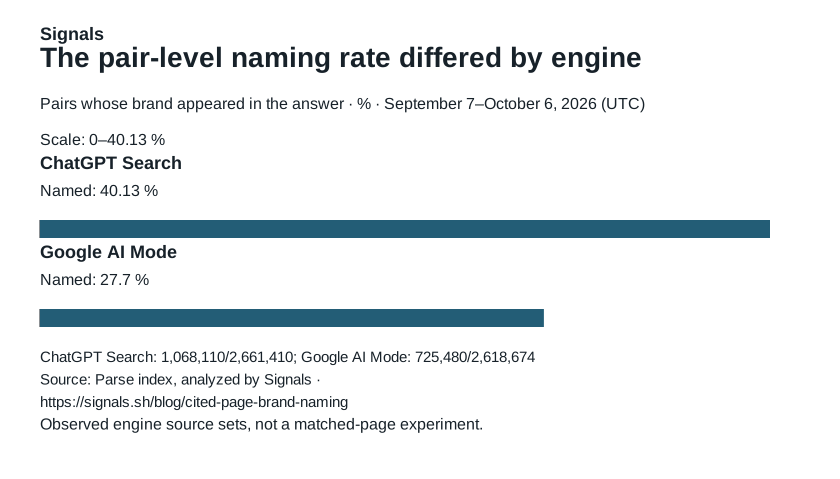
What does the naming rate actually measure?
The 34.0% figure asks whether a brand detected on a cited page also appeared in the answer that cited that page. It describes 5,280,084 page-brand-answer pairs observed from September 7 through October 6, 2026. It does not measure how often an arbitrary published mention becomes a citation or recommendation.
The distinction changes the denominator. These pages had already been cited. Uncited placements, failed publications, and pages outside the tracked questions are not represented in the naming rate. A page cited in several answers can contribute several observations, and a page listing several brands contributes a pair for each detected brand.
Read the number as a reason to inspect the actual answer. A placement report showing a cited URL is incomplete if the objective was brand naming. Conversely, an answer naming the brand may have used several sources. The observed pair is not proof that the particular page supplied the decisive information.
Does a prominent mention outperform a passing reference?
Prominence is worth specifying because it changes how useful the article is to a reader, but the study's prominence groups are observational labels. They do not represent an experiment that moved the same brand from a passing reference into a dedicated section. Use the split to inspect candidate pages, not to price a guaranteed outcome.
A dedicated paragraph should explain the product's fit, constraints, and evidence. It should not repeat a brand name merely to increase the count. The study also groups detected mention frequency; pages with more mentions may differ in length, topic, familiarity, or commercial intent.
Request a draft excerpt before committing to publication. It should remain intelligible outside the surrounding article: which product, which use case, and what factual distinction. If the paragraph could be pasted into any vendor's profile unchanged, the problem is the brief. A more prominent position will not fix missing information or an unsupported claim.
Should the publisher already appear in AI answers?
Prior citation is useful evidence for selecting a publisher because it shows the host has appeared in a relevant source set. It is not a promise that another page on the same domain will be cited. We would inspect topic fit and the specific article before using a domain's historical visibility as a buying criterion.
Save the question, engine, dated answer, and cited URL behind any vendor claim that a publisher is already used by AI. A homepage screenshot or a global domain score does not identify which buyer question the proposed article will answer. The destination page must still offer something worth reading.
This batch does not include a controlled comparison of placements on previously cited and uncited hosts. It also lacks a complete delivered-URL ledger for blog mentions. We therefore cannot quote a measured lift for either choice. The practical advantage of prior citation is a better-grounded shortlist, not an established service effect.
When does a brand-mention brief work, and when does it fail?
The brief works when the proposed article has a real editorial purpose and the brand adds specific information to it. It fails when publication itself becomes the only acceptance criterion. We judge the planned passage before the host's sales pitch because a recognizable domain can still publish an irrelevant or empty article.
Use the following checks during the editorial review:
| Element | Works when | Fails when |
|---|---|---|
| Brand identity | Name and product are unambiguous | The name could refer to another company |
| Context | The passage answers a buyer constraint | It reads like a sponsor list |
| Evidence | Claims can be checked against documentation | The draft invents customer experience |
| Editorial fit | The article belongs on that host | The category exists only to sell placements |
These are editorial acceptance rules, not coefficients from the study. Apply them to DIY outreach and purchased execution alike. A clear rejection rule is more useful than a promised number of AI mentions.
What should the placement specification include?
Give the publisher a brief that names the audience, the article's question, and the specific product facts that support the answer. Specify the proposed host and page format before buying. An editorial comparison, a tutorial, and a company announcement should not be treated as interchangeable inventory because each answers a different reader need.
Include the canonical brand name, official product URL, supported claims, limitations, and the source for any performance statement. Ask for the proposed passage, disclosure, publication URL, and the publisher's policy on edits or removal. A useful proof packet lets another operator find and inspect the result without asking the writer what happened.
Set a delivery window for drafting and publication, while keeping AI pickup outside that promise. Avoid requirements for fabricated testing or an undisclosed endorsement. The brand can supply accurate evidence; the publisher still needs to decide how that evidence fits the article. Record material edits after delivery so the measurement has a stable reference.
How should sponsored content be handled?
Keep the commercial relationship clear and evaluate the content on the same factual standard as any other article. We did not measure a causal penalty or benefit for sponsored labels in this batch. A vendor claiming that AI ignores disclosure needs evidence beyond a collection of cited sponsored pages or an isolated answer screenshot.
A label does not make an unsupported claim reliable. The article still needs a genuine topic, accurate product information, and a reason the brand belongs in the comparison. Likewise, an unlabeled article is not automatically independent evidence. Ask who selected the products and who checked the factual statements.
Keep the disclosed relationship in the delivery record. If a later analysis compares sponsored and other articles, it will need consistent labels and comparable publishers. For the current decision, choose transparency and substance. Do not rewrite the commercial relationship to fit a theory that the available measurements have not tested.
How long until a mention affects an answer?
This analysis cannot measure the delay from publication to citation or brand naming. It connects observed answers with the latest measured page content, but it does not have reliable publication timestamps for every passage. A crawl timestamp is an observation date, and treating it as the article's birthday would create a misleading lag estimate.
For future work, save the original publication receipt, the final URL, and any subsequent edit dates. Keep asking the same buyer questions on the same engines. Record when the page first appears and when the brand first appears; those events can happen separately or never occur in the monitored panel.
Choose a review schedule based on your operating needs, not a forecast derived from this study. A week with no observed change is a missing result within that panel, not proof that the page was unread everywhere. A new mention is also not proof that the placement caused it.
How should we compare a campaign with its baseline?
Use a fixed set of questions and preserve the answers before publishing. The comparison should hold the brand, questions, and engines steady while recording other changes that could matter. The AI visibility guide provides the planning framework; the cited-page study supplies the exact denominator behind this article's headline.
Record naming, citation presence, and recommendation wording separately. A brand can be named negatively or as a poor fit. Counting all appearances as wins would conceal that distinction. Store the source URL as well as the answer so the result can be reviewed later.
The study splits its observations by engine, page shape, prominence, and mention count. Those cuts help evaluate which comparison is relevant to the proposed article. They do not remove differences between brands or topics. Report the observed before-and-after movement as such until a design with credible controls supports a stronger claim.
The one-page coverage study tests whether a single cited page contains every brand named in an answer.
Questions operators ask about brand mentions
The recurring questions mix traditional links with AI naming, so the answer needs to preserve those separate outcomes. We can document what a page says and whether a measured answer names the brand. We cannot infer a ranking signal, an endorsement, or a service effect merely because those events appear in the same report.
What is an unlinked brand mention?
It is a reference to a brand without a clickable link to the brand's website. The relevant context can still be read, but this study does not isolate the effect of link status.
Are brand mentions better than backlinks?
This analysis did not compare their effects. Keep useful references and links together; choose the article for its relevance rather than forcing that tradeoff.
Can buying a mention guarantee a ChatGPT recommendation?
No guarantee follows from these data. The sample starts with already-cited pages and contains no controlled test of a Signals placement service.