How much do Reddit upvotes cost in 2026? (per-subreddit price tiers)
Reddit upvotes cost $0.01 to $0.50+ in 2026. The per-subreddit price tiers, why $0.05 votes almost always get fuzzed, and the cost-per-retained-vote math operators actually run.

Reddit upvotes cost between $0.01 and $0.50+ per vote in 2026, but the operator-grade band is $0.10 to $0.30. Below $0.10 the votes are almost always fuzzed, purged, or weighted near zero by Reddit's Contributor Quality Score before they affect ranking. Above $0.30 you are paying for delivery infrastructure - aged-account drip pacing, IP rotation, and CQS-Moderate voter pools that survive the first hour and pass timing-entropy checks.
Reddit upvote pricing runs a 50× spread in 2026, from a $0.01 floor on bulk-farm services like Upvote.net to a $0.50+ ceiling on vendors who deliver from aged residential accounts on a 1-6 hour drip. Most operators land in the middle - the REDAccs 2026 pricing tiers are typical, with bulk packages at $0.10/vote, mid-tier at $0.07-$0.08, and 66,000-vote enterprise orders at $0.045. The headline number is misleading because Reddit's algorithm does not treat all votes as equal. Signals runs an aged Reddit account marketplace plus an editorial network for AI brand mentions across Reddit, Quora, Product Hunt, and Threads, and the cost-per-retained-vote math we ship into client campaigns rarely matches the order-page price. This is the honest 2026 price map for a Reddit upvote, organized the way an operator actually shops: by subreddit tier, by delivery curve, by voter quality, and by what each price band buys after attrition. When a buyer chooses to buy Reddit upvotes at any tier, the question is whether the package velocity matches the subreddit's baseline.
$0.01 (Upvote.net 2026 pricing) Headline floor for Reddit upvotes - flat-rate, instant delivery from low-CQS account pools.
$0.10-$0.30 (Signals operator-grade band, 2026) Range where aged-account drip-fed votes survive the first hour and carry near-full algorithm weight.
0.7% (Reddit Transparency Report H2 2024) Share of admin removals attributed to content manipulation across 158.96M removed items.
<50% (REDAccs $480 audit, 2026) First-week vote-purge survival on cheap packages versus 80-95% on quality drip-fed orders.
What is the headline 2026 price range for a Reddit upvote?
Sticker prices run from $0.01 to $0.50+ per upvote, but the operator-relevant range is $0.07 to $0.30. The bottom end is Upvote.net's flat $0.01 rate and the $0.02 tier on services like UpvoteLift and BuyUpvotes - delivered as a 5-30 minute blast from low-aged accounts on shared proxy pools. The top end is custom drip campaigns at $0.30-$0.50 per vote where the vendor is selling delivery infrastructure, not just votes. The middle band where most working campaigns ship is $0.07 to $0.15, with REDAccs at $0.045-$0.10/vote and Upvote.Shop, SocialPro, and SocialPlug clustered at $0.10-$0.15. Pricing is uniform across subreddit topic on most order pages - vendors do not tier by sub - so the per-subreddit logic has to come from the buyer matching package volume and delivery curve to the subreddit's baseline.
How does pricing change with package size?
Bulk discounts collapse the per-unit price by 30-60% at the top end, but they do not change the underlying voter quality. The published REDAccs ladder is representative: a 100-vote starter pack runs $0.10/vote, a 620-vote basic pack runs $0.08/vote, a 2,850-vote standard pack runs $0.07/vote, and a 66,660-vote marketer pack runs $0.045/vote. Other vendors price the same shape - smaller deposits cost more per vote, but every tier ships from the same account pool, so the only difference is unit cost, not retention or weight. Bulk pricing is real for repeat operators running multiple campaigns; for a single launch post, it rarely matters because the velocity ceiling on any one post tops out at a few hundred in-window votes before the delivery curve mismatches the subreddit baseline.
Why are sub-$0.10 Reddit upvotes priced that way?
The unit economics force every shortcut Reddit's anti-manipulation stack is tuned against. Maintaining a single aged voter account through 6+ months of warmup, Contributor Quality Score preservation, residential IP isolation, and unique browser fingerprints costs more than the $0.01-$0.05 the cheap services charge per delivered vote. The math only works if the voter accounts are disposable - and disposable is exactly the profile Reddit's anti-manipulation detector flags first. Derek Hsieh's 2021 Kafka Summit talk described how Reddit moved vote-manipulation detection from hourly Airflow batches to ksqlDB streaming, cutting detection time "from hours to minutes" by watching for statistically anomalous bursts in real time. A $0.05 package that drops 200 votes in 3 minutes from a clustered IP pool produces the exact entropy signature that streaming detector is built for.
How does subreddit tier change what you actually need to spend?
Subreddit baseline velocity decides how many votes a campaign needs, not the order page. Small subreddits (under 50,000 subscribers) often crest into in-subreddit Hot with 30-75 in-window upvotes; mid-size subs (50,000-300,000) typically need 200-500 inside the first two hours; defaults and large subs need thousands with sustained engagement. The 2026 Search Engine Land Reddit SEO analysis and operator testing on BlackHatWorld consistently put the dollar floor for a working niche-sub campaign at $7-$25 (75-250 quality votes) and a working mid-sub launch at $30-$120. Trying to buy front-page-of-default placement is a different kind of order entirely - it requires sustained drip across 4-12 hours, voter-CQS at Moderate or higher, and budgets that start at $400-$1,500 before organic tail.
| Subreddit tier | Subscriber range | Votes to crest Hot | Operator budget at $0.10-$0.15/vote |
|---|---|---|---|
| Niche / hobby | <50,000 | 30-75 | $5-$15 |
| Niche-pro / vertical | 50,000-300,000 | 100-300 | $15-$45 |
| Mid-default | 300,000-1M | 400-800 | $50-$120 |
| Default-large | 1M-5M | 1,500-4,000 | $200-$600 |
| r/popular eligibility | Multi-default | 5,000-20,000 | $750-$3,000 |
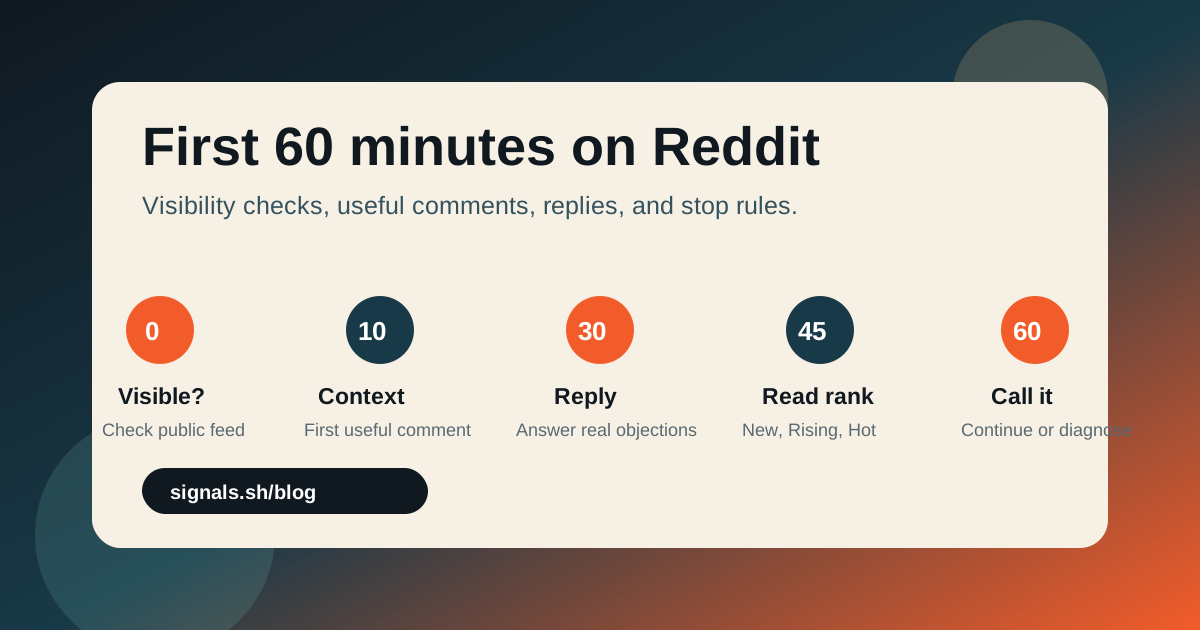
The numbers above assume the post is Reddit-native and the package is dripped into the first 60 minutes; outside those conditions the budget gets larger and the outcome gets worse, not the other way around.
Cheap upvotes vs quality upvotes: a side-by-side price comparison
The differences are usually invisible on the order page and obvious in the campaign data. A vote from a 14-day-old farmed account on a shared proxy pool and a vote from a 6-month-old aged account on a residential IP are not the same product, even when the order page on both vendors says "real users."
| Cost factor | Cheap package ($0.01-$0.05/vote) | Quality package ($0.10-$0.30/vote) |
|---|---|---|
| Voter account age | 1-14 days, often farmed | 3-12+ months, organic comment history |
| Voter CQS tier | Lowest / Low | Moderate / High |
| Effective vote weight | ~0.05-0.15× full algorithm weight | ~0.8-1.0× full algorithm weight |
| Delivery curve | 5-30 min blast | 1-6 hour drip matched to baseline |
| 7-day vote-purge survival | Often <50% (per REDAccs $480 audit) | Typically 80-95% |
| Detection signal to streaming detector | High (IP cluster + timing entropy) | Low (passes baseline checks) |
| Cost per retained, weighted vote | Frequently $0.30-$0.80 effective | Typically $0.13-$0.40 effective |
The price floor is not arbitrary. The $0.01 vote and the $0.30 vote often converge in cost-per-retained-weighted-vote terms once attrition and CQS scaling are applied - and the cheap package frequently costs more per moved-rank-position because more of its volume is purged or weighted near zero.
What does cost-per-retained-weighted-vote actually look like?
The price floor on the order page is the wrong number to compare. The right number is cost per retained, weighted, in-window vote, which can be 3-8× the headline price after attrition, CQS scaling, and delivery-curve mismatch. The REDAccs $480 audit tested six services with controlled orders: UpvoteShop's $0.01 vote retained at 99.2% over 7 days, while UpvoteMax's higher-priced order retained at 68.8% over the same window - the headline price did not predict outcome. CQS scaling adds another layer: votes from Lowest-CQS accounts contribute near-zero ranking weight before any purge fires, so a $0.05 package weighted at 0.1× equals a $0.50 package on effective-weight basis. Delivery-curve mismatch is the third multiplier - a package dripping after hour 4 is fighting a 12.5-hour time-decay curve that has already cut leverage by ~90%. The cost-per-retained-vote math is the only honest scorecard, and it is the one most order pages do not show.
How do delivery curves change the price?
Delivery curve is half the product. A flat $0.10/vote price hides whether the vendor will dump the full order in 8 minutes or drip it across 4 hours, and that decision swings retention from <50% to 95%. The Reddiquette page confirms the design intent: vote scores are "intentionally fuzzy" so bots cannot measure their own throughput, and timing-entropy on a vote stream is the signal Reddit's streaming detector reads first. A drip curve that spreads votes across the first 60 minutes of post life at a rate within 2-3× the subreddit's organic baseline passes the timing check and applies leverage where the algorithm is most sensitive. A blast curve trips the detector and produces a brief vote count that the algorithm reverts before the post leaves Rising. Vendors who charge a premium for "drip" are charging for the curve, not the votes - and that curve is what the headline price often hides.
What price should a 2026 operator actually pay?
For an operator-grade campaign on a Reddit-native post in a niche or mid-sub, target $0.10-$0.20 per vote with a drip curve into the first 60 minutes and voter accounts at CQS Moderate or higher. That price band is where retention, weight, and timing converge into a package that actually moves rank instead of moving money. For a default-sub launch, the same per-vote target applies but with strict delivery infrastructure - residential IPs, fingerprint isolation, drip across 2-6 hours, and total package velocity capped at 2-3× the subreddit's organic baseline. The default move for a first-time buyer is still to skip the order and sharpen the post first - title, hook, first comment, posting time, subreddit fit - because organic velocity beats any paid package on a well-targeted launch. Paid upvotes are timing infrastructure for posts that already deserve to rank but landed in a slow window; they are not a substitute for a Reddit-native post.
Frequently asked questions
What is the cheapest legitimate price for Reddit upvotes in 2026?
The lowest credible price for an upvote that actually carries algorithm weight is around $0.07-$0.10 per vote, and only when the vendor is running aged accounts on residential IPs with a drip delivery curve. Anything below $0.05 almost always ships from short-aged accounts on shared proxy pools, which means the votes are either purged inside the first hour or weighted near zero by the Contributor Quality Score before they affect ranking. The "$0.01 upvote" is real as a sticker price but rarely translates into rank movement.
Does Reddit charge more for upvotes on bigger subreddits?
No - vendor pricing is uniform across subreddit topic and size on every major service we tested. The order page does not tier by sub. Per-subreddit cost differences come entirely from how many votes you need to crest Hot in that sub. A 75-vote niche-sub campaign at $0.10/vote costs $7.50; a 4,000-vote default-sub campaign at the same per-unit price costs $400. The price changes because the volume changes, not because the vendor charges more for r/SaaS than r/microsaas.
Why do $0.05 Reddit upvotes almost always get fuzzed?
Because $0.05 is below the unit-cost floor for an account that can pass Reddit's anti-manipulation streaming detector. Vendors at that price point cannot afford aged accounts, residential IPs, unique fingerprints, or drip pacing - they batch-deliver from clustered low-CQS accounts inside a few minutes. The votes display briefly, then either get purged in the next sweep or get weighted so close to zero that the post does not move. What buyers call "fuzzing" at that price is usually CQS scaling plus instant purge, not the actual vote-fuzzing display layer.
What is the difference between drip-fed and instant Reddit upvotes?
Instant delivery dumps the full package in 5-30 minutes; drip delivery spreads the votes across 1-6 hours matched to the subreddit's baseline velocity. The difference at the algorithm layer is enormous - instant blasts trigger the timing-entropy detector and frequently lose 50%+ of votes inside a week, while drip-fed packages from aged accounts retain 80-95% past the 24-hour mark per the REDAccs $480 audit. Drip is not a marketing label; it is what makes the package survive the first hour.
Are bulk Reddit upvote packages worth it?
Yes for repeat operators, no for one-off launches. The published bulk discount on most vendors collapses per-unit price 30-60% at the top tier, so a 60,000-vote package at $0.045/vote works for an operator running 30+ campaigns a quarter. For a single post, the velocity ceiling tops out at a few hundred in-window votes before the package velocity outpaces the subreddit baseline, so buying in bulk does not help any single campaign. The honest test: if you cannot use 5,000+ votes inside 90 days at the right per-post drip cadence, the smaller pack is the better buy.
Will buying Reddit upvotes get my account banned?
The vote-buying account itself is at low risk because the buyer typically does not vote on their own post; the voter accounts are the ones that absorb enforcement. Reddit's H2 2024 Transparency Report shows content manipulation accounted for just 0.7% of admin removals across 158.96M items, with most enforcement landing on the manipulating accounts under the Disrupting Communities policy. The full ban-risk picture, including OP-side suspensions and shadowbans tied to repeated manipulation, is covered in our breakdown of whether buying Reddit upvotes gets you banned in 2026.
Do upvote services support specific subreddits like r/SaaS or r/CryptoCurrency?
Most do, but the per-subreddit success rate depends on the sub's moderation aggression and AutoMod ruleset, not the vendor's price. Promotional subs with strict AutoMod (r/Entrepreneur, r/marketing, r/SaaS) require Reddit-native posts and aged voter accounts to pass the first-hour filter; permissive subs (r/microsaas, r/SideProject, r/CryptoCurrency for project posts) tolerate a wider package profile. The vendor's job is to deliver weight-bearing votes; passing the subreddit's first-hour filter is still on the post quality.
How does this compare to the price of a Reddit account?
Different product, different math. A Reddit upvote prices the action; a Reddit account prices the inventory that performs the action. Operators running their own campaigns from purchased accounts pay $15-$75 per account once and then run their own votes for free; operators outsourcing the velocity pay $0.10-$0.30 per vote and skip the account-handoff work. The break-even is around 200-400 votes per account before the buy-and-DIY path beats the paid-vote path on a per-campaign basis, which is why most operators run a hybrid - aged accounts for posting and commenting, paid upvotes only for the first-60-minute velocity boost.