Do press releases help AI visibility? What 7.43M citations say (2026)
Wire hosts supplied 0.065% of measured citations. The release brief, wire comparison, and honest limits on AI visibility.
Originally published April 16, 2026

Use a press release to publish an announcement, and judge AI visibility through the sources buyers actually see. Wire hosts supplied 0.065% of measured citations in our sample. That small direct share is a reason to scrutinize an AI-visibility pitch, not a reason to declare every press release worthless.
This refresh replaces the earlier guide's borrowed headline with a fresh Parse measurement. The companion press-release study contains the wire-by-wire results, title groups, engine split, and reproducible counting method. It measures direct wire citations, not the full downstream reach of an announcement.
Signals runs an aged Reddit account marketplace plus an editorial network for AI brand mentions across Reddit, Quora, Product Hunt, and Threads.
Do press releases help SEO and AI visibility?
A release can provide a public, attributable record of news. Our AI-search data establish a narrower finding: direct citations to the selected wire hosts were uncommon in the measured answers. We would not buy distribution on the assumption that a syndicated announcement will reliably become a source for product recommendations.
The sample contains 4,850 wire-host citation occurrences out of 7,429,354 citations from July 9 through October 6, 2026. It covers ChatGPT Search and Google AI Mode. Those engines, dates, and tracked questions define the result; the percentage is not a universal measure of press-release value.
Traditional search rankings, journalist discovery, investor communication, and customer announcements are different objectives. A release can serve those purposes without appearing in this panel. Set the objective first. If the objective is AI naming, insist on a measurement of naming instead of accepting distribution reach or the number of syndicated URLs as a substitute.
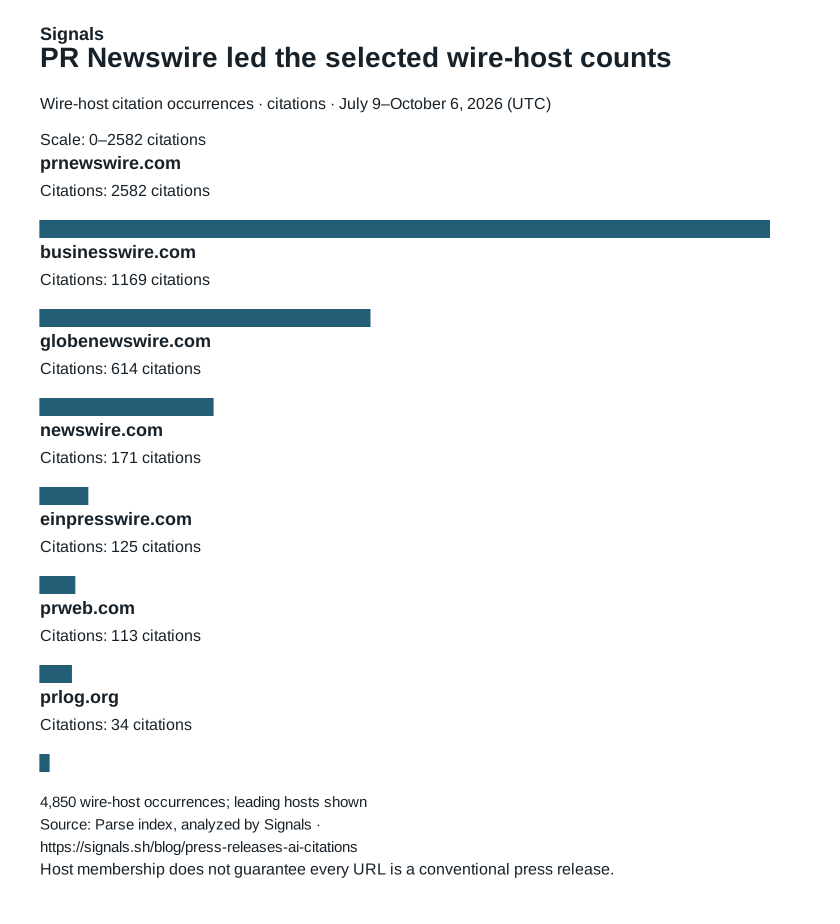
Which wire appeared most often in the sample?
PR Newswire's main host led the selected wire-host table with 2,582 citation occurrences. That makes it the largest observed host in this cut, not the proven best distribution purchase. We do not know the number of releases available on each wire or the relevance of every release to the tracked questions.
Business Wire and GlobeNewswire also appear in the table. Host totals include the pages that happen to live there, which can include material beyond a conventional release. The study therefore labels the measure wire-host citations and publishes the matching rules instead of pretending every page was manually verified.
Before choosing a wire, evaluate the audience, actual delivery terms, and the announcement's purpose. A global citation leaderboard cannot establish which service will reach the right journalist or buyer for a particular company. For AI work, save the exact release URL and the subsequent answers that cite it. Keep publisher promises separate from observed results.
What announcement topics showed up?
Launch language appeared in 1,203 wire citation occurrences, while the rest included funding, partnership, and unclassified titles. These are keyword-based groups, not a manual assessment of the news or its quality. Use the split to understand the observed material, not to rewrite an ordinary update as a funding or launch story.
The classifier assigns a title to the first matching group. A launch announced alongside a partnership can therefore end up in one category even though both descriptions are reasonable. We also count repeated citations, so a frequently cited page contributes more weight than one cited once.
The useful writing rule is independent of that ranking: state what changed, who it affects, and where the claim can be checked. A release announcing an integration should identify the actual compatibility and availability. Inflated language makes the announcement harder to evaluate, and it does not solve the missing evidence behind an AI-placement promise.
Is editorial pickup the real opportunity?
Editorial pickup is a plausible route from an announcement to sources buyers encounter, but this study did not measure that route. We counted direct wire-host citations. An article on another publication would sit outside the wire numerator even if the release helped the journalist discover the news, so the direct share cannot measure all influence.
That also means we cannot claim the uncounted share belongs to press-release-driven editorial coverage. Establishing pickup would require linking a specific release to subsequent articles and distinguishing independent reporting from copied syndication. Measuring a brand's resulting AI naming would add another step and another set of possible explanations.
Build a pickup report around named articles and what they add. A journalist's original comparison, an interview, and a verbatim repost should not be reported as the same editorial result. Parse's publisher study provides related source-level context, without establishing a causal effect for a distribution purchase.
When does distribution work, and when does it fail?
Distribution fits an announcement with a real audience, verifiable facts, and a clear publication objective. It fails as an AI plan when the proposal promises recommendations without specifying how they will be measured. We would approve the news and delivery plan first, then define AI observation as a separate follow-up task.
Use this comparison to review the brief:
| Element | Works when | Fails when |
|---|---|---|
| News | A specific change matters to an audience | The release restates the homepage |
| Evidence | Claims have attributable sources | The copy invents market leadership |
| Delivery | Named destinations and terms are clear | A large URL count stands in for readership |
| Measurement | Citations and naming are checked directly | Distribution is reported as AI visibility |
These are decision rules, not measured effect sizes. A release that meets them can still receive no citations in the monitored questions. An honest campaign report should preserve that outcome instead of substituting a different success metric after publication.
What should the release itself contain?
Write the announcement so a reader can identify the change without decoding promotional language. Name the company, product, event, and relevant date clearly. Put the supporting facts near the claim they support. The release should function as a reliable source for someone verifying the news, even if no AI engine ever cites it.
A product launch needs the actual product description and availability. A partnership needs the scope of the relationship rather than a vague statement about shared ambition. A funding announcement needs attributable terms that the company is prepared to publish. Avoid adding claims about customers, performance, or category leadership that the record cannot support.
Include a contact and an official destination for further detail. Use quotes only when they add information or a real viewpoint. A release does not improve because every executive repeats the announcement in different words. The buyer, journalist, or researcher should leave knowing what changed and how to verify it.
What should a distribution vendor promise?
Ask for the named wire or publication destinations, the format, the editorial requirements, and the publication window. Clarify which deliverables are guaranteed and which depend on editorial discretion. A distribution purchase, an original reported article, and a sponsored placement are different products; the contract should identify the one being supplied before work begins.
Request a proof packet containing the published release URL, timestamp, final text, and any additional pickup URLs. Have the vendor distinguish copied syndication from independent coverage. If an AI result is part of the proposal, require the exact prompt, engine, answer date, and supporting citation rather than a cropped screenshot.
We do not have the delivered-URL ledger needed to measure a Signals press-release service in this batch. Do not import the index's host totals into a vendor performance claim. They describe observed sources across the panel, not completed orders, customer outcomes, or the probability that a new release will be cited.
How long should AI pickup take?
We cannot give a measured publication-to-citation delay for releases from this analysis. Reliable publication dates and release-to-pickup relationships are missing for too much of the corpus. The time Parse first observed a URL is not a substitute for its publication date, and mixing the two would manufacture a lag estimate.
For new work, save the live release receipt at publication and monitor the same buyer questions afterward. Track direct wire citations separately from citations to subsequent articles. If the brand becomes newly named, preserve the full answer and all its sources instead of assigning the change automatically to the release.
Set the reporting date as a project decision. It should tell the team when to review the evidence, not promise when an engine will change its answer. A release might be relevant to news questions while the monitored panel asks product-selection questions. That mismatch belongs in the interpretation, not in a revised deadline.
How should we allocate the next PR budget?
Choose the work that answers the actual communication problem. If the company has news to announce, evaluate a release against that objective. If buyers lack a credible explanation of product fit, an editorial comparison or documented example may be the more relevant brief. The citation share alone cannot price those alternatives or prove their return.
Start with the AI visibility guide to define the questions. Read the sources currently answering them and identify the missing evidence. The press-release study explains the wire-host measurement, including its exclusions and the separate engine totals.
Keep the before-and-after answer panel stable if you proceed. Record other campaigns, product changes, and new coverage during the same period. A change after publication is worth investigating, but it is not automatically an effect of distribution. The strongest budget argument will connect the intended audience, concrete deliverable, and observed outcome without skipping those steps.
Questions operators ask about press-release SEO
These questions separate distribution from the outcomes often attached to it in a sales pitch. Our data answer the direct-citation question for a defined sample. They do not determine the value of every announcement, prove an SEO ranking effect, or measure the downstream influence of all coverage that a release might have prompted.
Do press releases help SEO?
This study does not estimate a search-ranking effect. It measures direct wire-host citations in AI answers; assess an announcement against its intended audience and communication purpose.
Is PR Newswire better than Business Wire for AI search?
PR Newswire had more observed citations in this cut. We lack release-volume denominators and a controlled purchase comparison, so the ranking does not establish which is better for a new order.
Should we stop publishing press releases?
The data do not support that blanket conclusion. They support being cautious about buying distribution specifically for promised AI recommendations.