How Reddit detects vote manipulation in 2026 (the actual signals)
IP clustering, vote-timing entropy, account-graph walks, and CQS-weighted vote weight. The detection stack Reddit actually runs and the signals to avoid.

Reddit detects vote manipulation in 2026 through a four-layer stack: a streaming kSQL anomaly detector that reads the live vote bus and flags timing-entropy bursts in minutes, an account-graph engine that clusters co-voters by IP, ASN, and device fingerprint, the Contributor Quality Score (CQS) that down-weights or zeros out votes from low-trust accounts before enforcement even fires, and a slower admin-and-moderator review tier that lands suspensions and subreddit bans. The cheapest packages fail at the first three layers before any human ever looks.
The honest read on Reddit's detection stack in 2026 is that most paid vote bursts never reach a human reviewer. They are absorbed at the rails. Reddit's policy on vote cheating and vote manipulation frames the rule simply: no multi-account voting, no coordinated voting from organized groups, no vote services or automation, and Reddit reports it removes around 100,000 accounts per day under that umbrella, often before users encounter them. What changed is the time-to-detection. Derek Hsieh's Kafka Summit Americas 2021 talk described the migration from hourly Airflow batch jobs to a kSQL streaming pipeline that reads the live vote stream and catches anomalies "in minutes, not hours." That window has only tightened since. Signals runs an aged Reddit account marketplace plus an editorial network for AI brand mentions across Reddit, Quora, Product Hunt, and Threads, and we have shipped thousands of Reddit upvote campaigns since 2017. The detection signals that decide whether a campaign holds are the same ones that decide whether buying Reddit upvotes is worth the spend at all.
100,000/day (Reddit, March 2026) Accounts Reddit reports removing daily for spam and malicious bot activity.
hours to minutes (Derek Hsieh, Kafka Summit Americas 2021) Detection latency reduction after migrating from hourly Airflow jobs to kSQL streaming.
2007 (Reddit Reddiquette / Cyber Omelette analysis) Year vote fuzzing was introduced as the explicit anti-bot display layer, decoupled from internal scores.
5 tiers (Reddit Help on CQS) Contributor Quality Score buckets (Lowest, Low, Moderate, High, Highest) that re-weight votes before ranking math.
What does Reddit count as vote manipulation in 2026?
Reddit's policy is broader than most operators assume. The Reddit Help page on vote cheating and vote manipulation names three buckets explicitly: creating and using multiple accounts to vote on your own content, employing voting services or scripts to manipulate counts, and coordinating votes through organized off-platform groups. The Disrupting Communities policy extends that to brigading (posting a link to another community to drive directed voting) even when the votes themselves are real users. The practical line in 2026 is simple: any pattern where the vote signal is shaped by anything other than independent users encountering the post organically counts as manipulation, whether the actor is a bot, a paid service, a coordinated Discord, or the OP's other accounts. Enforcement does not require intent. Pattern is enough.
The four detection layers Reddit's anti-manipulation stack uses
Detection is not one system. It is a stack, and packages fail at different layers depending on how they are built. Reddit does not publish the architecture, but the public references (Hsieh's Kafka talk, TechCrunch's 2016 algorithm overhaul reporting, the New America OTI Protecting the Vote analysis, the CQS documentation, and the operator forum reverse-engineering on BlackHatWorld) describe four cooperating layers. Each runs at a different latency and applies a different consequence, and a campaign that survives one layer can still be killed at the next.
| Layer | Primary signal | Latency | Consequence |
|---|---|---|---|
| Streaming anomaly detector | Vote rate, timing entropy, burst clustering on live bus | Minutes | Instant vote purge, often inside the first hour |
| Account-graph engine | Co-voter overlap, IP, ASN, device and browser fingerprint | Hours to days | Account batch suspensions, voter-network blacklisting |
| CQS vote-weight scaler | Account age, karma, network, history, security signals | Continuous | Vote weighted near zero or filtered before counting |
| Admin and moderator review | Mod reports, user reports, post-level investigation | Days to weeks | Subreddit bans, sitewide suspensions, policy-scale removal |
How fast does Reddit catch a vote manipulation burst now?
Minutes, not hours. The most cited public reference is Derek Hsieh's Kafka Summit Americas 2021 talk, which described Reddit's data engineering team moving anti-manipulation rules off hourly Airflow jobs and onto a kSQL streaming pipeline. The kSQL job reads the live vote bus, applies windowed aggregations against per-subreddit baseline rates, and emits flagged events that downstream services consume to purge votes or escalate accounts. The architectural shift is the reason a $0.05 burst-delivered package now reliably evaporates inside the first hour: the detector no longer waits for a batch run that lets a manipulated post crest first. For paid campaigns, the practical implication is that delivery curve has become a primary safety variable. A 200-vote burst inside three minutes on a subreddit that organically averages 15 votes an hour creates the exact statistical anomaly the streaming detector is built for, and the votes are gone before the post leaves Rising.
Account-graph walks: how clustered voters get caught
The graph layer is where bot farms collapse. Reddit's account-linking signals, described across the Reddit Help CQS documentation, the Cyber Omelette reverse-engineering analysis, and operator-side observations on BlackHatWorld, combine IP, ISP, ASN, device fingerprint, browser fingerprint (User-Agent, screen, fonts, timezone, locale, canvas, WebGL), session behavior, and co-voting overlap to cluster accounts that "look the same" even when each individual identifier is rotated. Once two accounts are in the same cluster, a flag against one weights against the cluster. Bot farms running 50 accounts behind a shared antidetect-browser pool typically pass the first hour of any single campaign and then collapse on the next, because the cluster signature has been written. This is why operators who watch one round work and the next round fail are usually not seeing "Reddit changed something." They are seeing the graph layer catch up to the previous burst.
IP and device fingerprinting: the cheapest packages fail here first
Sub-$0.10 vote packages live on shared residential proxy pools and farmed accounts created in batches. The Cyber Omelette analysis mapped this empirically. Accounts upvoting the same post from the same /24 subnets, the same VPN exit nodes, or the same browser fingerprint cluster get linked deterministically, and Reddit's policy explicitly names "linking accounts that upvoted posts/comments through IP addresses, ISPs, or fingerprinting methods" as a detection vector. The economics push cheap packages into the worst possible profile: many accounts, few IPs, identical fingerprints, single-purpose vote behavior. That is the cluster the graph layer is fastest to catch. Quality packages survive this layer by spreading votes across isolated residential infrastructure with one account per IP and per device fingerprint, an amortized cost that the $0.05/vote price tier cannot pay for.
Vote-timing entropy: what Reddit's anomaly detector measures
Timing entropy is the signal most operators underestimate. The streaming detector does not just count votes per minute. It measures the distribution of inter-vote intervals against a baseline learned from the subreddit's organic voting curve. Real users vote at irregular intervals shaped by feed scrolling, mobile push windows, and timezone clusters. Bots and burst-delivered packages produce inter-vote distributions with low entropy: votes spaced at near-uniform intervals, or clustered into sharp 30-second windows, or arriving in tight bursts that decay too cleanly. The Cyber Omelette reverse-engineering and the BlackHatWorld operator-thread observations describe the same pattern from opposite directions. The detector catches "unnaturally high rates of upvotes" because the rate is unnaturally regular, not just unnaturally high. A package that delivers 100 votes drip-fed across 60 minutes with naturalistic jitter passes; the same 100 votes in a 5-minute blast does not.
CQS as a passive detector: how vote weight collapses before enforcement fires
The most underrated detection layer is the one that runs continuously and never produces a notification. The Contributor Quality Score, per our CQS internals breakdown, is a five-tier classification (Lowest, Low, Moderate, High, Highest) calculated from account age, karma, comment history, subreddit diversity, network and location signals, and account security signals like email verification and 2FA. CQS does two things relevant to vote manipulation. First, AutoMod can and does set rules like contributor_quality: < moderate to remove submissions and comments from low-trust accounts before they ever appear in the feed. Second, and this is the layer most paid-upvote buyers do not see, vote weight scales with CQS tier. Votes from Lowest-CQS accounts are weighted near zero before any anomaly detection fires. A 500-vote package on Lowest-CQS accounts can show on the post for hours and contribute the ranking equivalent of 25 real votes. Reddit does not need to detect or purge them; the math has already absorbed them.
What enforcement actually looks like
Enforcement is graded, and most operators conflate the visible action with the underlying signal. The four real outcomes (instant vote purge, vote-weight collapse, account suspension, subreddit ban) fire from different layers, on different timelines, with different reversibility profiles.
| Enforcement action | Triggered by | Latency | Visible to operator | Reversible |
|---|---|---|---|---|
| Instant vote purge | Streaming detector (timing entropy) | Minutes | Score drops back to baseline; post falls | No, votes are gone |
| Vote-weight collapse | CQS scaler | Continuous | Invisible; votes display, post does not move | Only by raising CQS |
| Single-account shadowban | Graph cluster + repeated violation | Hours to days | Posts vanish from feeds; profile 404 to others | Appeal via r/ShadowBan / modmail |
| Account suspension (3-day +) | Repeat violation, brigading, auto-bot rule | Days | Site notification, lockout | Appeal; usually within policy |
| Permanent suspension | Persistent vote services, ban evasion | Days to weeks | Permanent lockout | Rare; appeals usually fail |
| Subreddit ban (mod-driven) | Mod report, behavior pattern in their sub | Hours to days | Notification on submit attempt | Modmail appeal |
| Sitewide subreddit takedown | Coordinated manipulation, brigading sub | Weeks | Sub goes private or banned | Rare |
Reddit's Transparency Report for H1 2024 puts admin removals for "content manipulation" (the bucket that includes vote manipulation, brigading, ban evasion, and coordinated inauthentic behavior) in the low single-digit percentages of admin removals across the hundreds of millions of items removed in a half-year window. Most paid packages do not produce visible enforcement, but the failure mode is quieter than enforcement: they produce a post that did not move.
The detection signals operators control (and the ones they don't)
Operators control three of the four detection layers, partially. Streaming-detector exposure is controlled by delivery curve: matching package velocity to within roughly 2-3x the subreddit's organic baseline rate, dripping across the first 60 minutes, and adding naturalistic jitter to inter-vote intervals. Graph-layer exposure is controlled by voter infrastructure: one account per residential IP, isolated browser fingerprints, organic-looking session behavior, accounts with real comment history rather than vote-only profiles. CQS exposure is controlled by voter-account quality: aged accounts with karma, subreddit diversity, email verification, and behavioral history that pushes them into Moderate tier or higher. The fourth layer, admin-and-moderator review, is the one operators do not control. It fires on patterns that are visible to other users: a thread full of comments noting suspicious upvote patterns, a competitor reporting the post, a mod cross-checking with the streaming detector's flag list. The honest read for any paid campaign: the first three layers can be passed by paying for quality voters and a clean curve; the fourth layer is passed by making the post itself good enough that it does not generate the comments and reports that escalate it.
Frequently asked questions
Does Reddit detect every vote manipulation attempt?
No. Detection is statistical, not deterministic. The streaming layer catches the obvious (sub-$0.10 burst packages on clustered IPs) reliably. Sophisticated campaigns on aged voter accounts with diversified residential infrastructure and naturalistic timing curves often pass the streaming and graph layers. What gets them caught is usually the fourth layer: posts that are obviously off-pattern for the subreddit, get reported by users, and pull a mod or admin into the investigation chain. Detection is a probability gradient, not a binary, and the gradient is set by how clean the voter infrastructure is and how Reddit-native the post is.
How long does it take Reddit to catch vote manipulation?
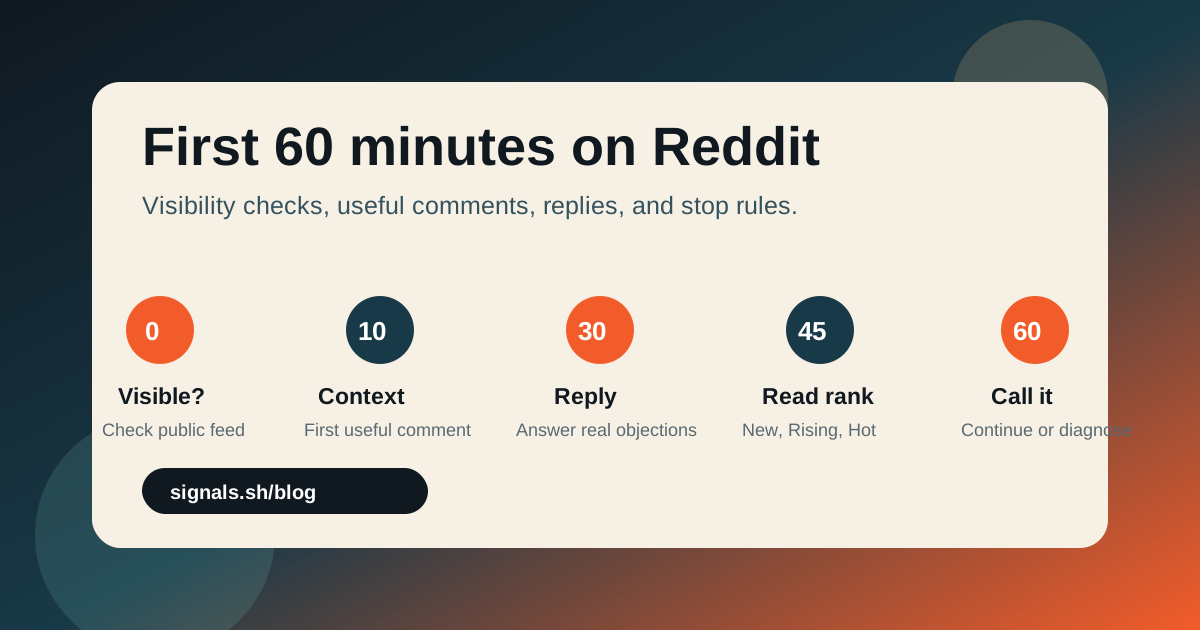
The streaming kSQL layer fires in minutes, often inside the first hour of the post going live, per the architecture Derek Hsieh described in his Kafka Summit Americas 2021 talk. The account-graph layer fires in hours to days as new co-voting events get joined into the cluster. Admin-and-moderator review can take days to weeks but produces the broadest consequences (subreddit bans, permanent suspensions). The relevant window for a paid campaign is the first 60 minutes. That is when the streaming detector decides whether the votes survive.
Is vote fuzzing the same as vote manipulation detection?
No. Vote fuzzing is a display-layer obfuscation introduced in 2007. Reddit deliberately scrambles the visible up/down breakdown so bots and outside observers cannot tell whether their votes registered. Net score, time decay, and CQS-weighted vote weight all use the unfuzzed values internally. Detection is a separate system entirely: the kSQL streaming pipeline, the graph engine, and the CQS scaler. Operators who see "+50, +52, +49" oscillate on a fresh post and assume their order is being clawed back are watching fuzzing, not enforcement. A real purge looks different: a sustained drop of dozens to hundreds in one tick, often paired with the post falling out of Rising inside the same minute.
Can Reddit detect upvotes from VPNs or residential proxies?
Yes, but with diminishing returns by infrastructure quality. Datacenter VPN exits are flagged by ASN and contribute strong cluster signals. Shared residential proxy pools (the kind cheap upvote services use) are caught by the graph layer once the same exit IP appears across multiple supposedly independent voters. Single-account residential IPs with consistent geolocation, ISP profile, and session behavior are functionally indistinguishable from real users at the network layer, which is why quality voter infrastructure is the primary cost driver in the package economics.
Do moderators see vote manipulation in their subreddits?
Mods see signal, not the underlying detection state. They see vote velocity that does not match the post's comment engagement, reports from users who notice the pattern, and AutoMod-flagged behavior on the OP's account. They do not see Reddit's internal CQS scores or the streaming detector's flag list. Mods can and do remove posts they suspect of vote manipulation and ban accounts from their subreddit; they cannot suspend accounts sitewide. Most subreddit-level bans for vote manipulation are mod-driven on pattern, not admin-driven on detector output.
Does buying Reddit upvotes always trigger detection?
No, but the cheapest packages reliably do. The detection profile is set by infrastructure and curve, not by "paid versus organic." Aged accounts on isolated residential IPs with organic comment history, dripped into the first 60 minutes at a curve matched to the subreddit's baseline, pass the streaming and graph layers because they look like real users having a normal afternoon. Burst-delivered farmed accounts on shared proxy pools fail in minutes because they look exactly like the manipulation profile the kSQL detector was built to catch. The price floor is not arbitrary. It tracks the cost of the infrastructure that passes detection.
What happens to my account if Reddit detects vote manipulation?
It depends on the layer that catches you and the persistence of the pattern. A first-time, low-volume violation typically produces a vote purge and nothing else. Repeated violations escalate to account-level enforcement: a 3-day suspension, then a 7-day suspension, then a permanent suspension. Accounts caught running vote services or coordinating votes through external groups are usually suspended permanently on first detection without a graduated warning, per Reddit's Disrupting Communities policy. Buyers of upvote services who never used multi-account voting themselves are usually unaffected at the account level even when the votes get purged. The enforcement falls on the voter accounts, not the recipient.