SynthID removal: how to test images before posting
Test SynthID removal with saved originals, separate detector checks and visual review. Learn what screenshots, metadata cleanup and redraw processing can prove.
Originally published October 9, 2026

SynthID removal needs a watermark check, not only a lower AI-detector score. Before processing an image for a social post, save the original, choose the exact result you want to test and set a limit on visible changes. Then compare the downloaded output against that baseline. A successful export is not the same thing as a verified removal.
This guide is for creators and operators working with images they may edit and publish. It covers the practical questions behind searches such as “remove SynthID from Gemini images,” “does a screenshot remove an AI watermark?” and “why does my image still get flagged?” The workflow separates what a tool changes from what a detector reports and what a publishing platform requires.
What does a SynthID remover need to change?
A SynthID remover must affect the watermark signal carried in the image. Deleting a filename or an EXIF field is a different operation. Google's original SynthID explanation says the mark is embedded in image pixels and can remain detectable when metadata is lost.
That distinction changes how we test a product. A file inspector can show that a metadata field disappeared. It cannot, by that result alone, establish that the watermark disappeared. A visible corner logo is a third thing: removing it changes a visible part of the image, not necessarily its invisible watermark.
Keep the terms specific when choosing a tool. “Metadata removed,” “watermark not detected by this verifier” and “generic detector classified the image as human” are three different results. If the product report combines them into a single success label, save the underlying responses or treat the result as unresolved. A precise record is more useful than an attractive badge.
Can an image pass an AI detector and still contain SynthID?
Yes: a generic classifier and a watermark verifier answer different questions. The classifier evaluates learned image patterns. The verifier looks for a particular embedded signal. Agreement is not guaranteed, and a negative result from either does not prove that an image was made by a camera.
Use this comparison to select the right check:
| Check | Question it can help answer | What its result does not prove |
|---|---|---|
| Metadata inspection | Which readable fields are present? | That pixel-level watermarks are absent |
| Content Credentials verification | Does this provenance record verify? | That every claim depicted in the picture is true |
| SynthID verification | Is a supported watermark detected? | That an unmarked file is a real photograph |
| Generic AI-image detector | How does this classifier label the file? | That SynthID was removed or a platform will accept it |
The C2PA explainer defines provenance verification separately from a judgment that the content is true. Preserve that distinction in your notes. One image can have several recorded signals without those signals being interchangeable.
Do screenshots, cropping or JPEG compression remove SynthID?
Do not assume that an ordinary export operation removes the watermark. Google's SynthID documentation describes resilience to common modifications, including cropping and lossy compression. That does not mean every imaginable transformation preserves detection; it means the operation's name is insufficient evidence.
Our operation-by-operation comparison separates likely file effects from the claim that would still need testing. It is a technical checklist, not measured success rates.
| Operation | What changes | What still needs verification |
|---|---|---|
| Metadata cleanup | Supported file records | Watermark signal in image content |
| Screenshot | A new capture of displayed pixels | Signal in the captured image, quality and color |
| PNG/JPEG/WebP conversion | Encoding and possibly pixel values | Watermark response on the actual export |
| Cropping or resizing | Framing or sampled image content | Detection and preservation of important details |
| Redraw processing | Some image content is reconstructed | Detection, factual detail and acceptable similarity |
A screenshot might also introduce a display scaling change you did not intend. Repeated conversion can damage text or edges. Test the final file you will use; an intermediate preview or a different export cannot stand in for it.
How can you evaluate Deprint on your own images?
Deprint offers supported metadata cleanup and experimental redraw processing aimed at reducing SynthID signal. It is another product from our founder. Treat it as a tool to evaluate against your own image requirements, with the original available for comparison.
The processing-mode guide describes lossless cleanup and modes that allow image changes. The current product does not guarantee watermark removal or a detector pass. Pick the mode based on the visual changes you can accept; a stronger transformation is not automatically the better output.
For a product image, inspect labels, controls and shape. For a portrait, inspect identity and small facial details. For an illustration, check that the concept and any text still make sense. Reject a result that changes a fact the post depends on, even if its detector score falls.
Use the exported file in a separate verification step. Save what each checker actually returned. The workflow below is designed to make those results comparable, not to certify a universal removal method.
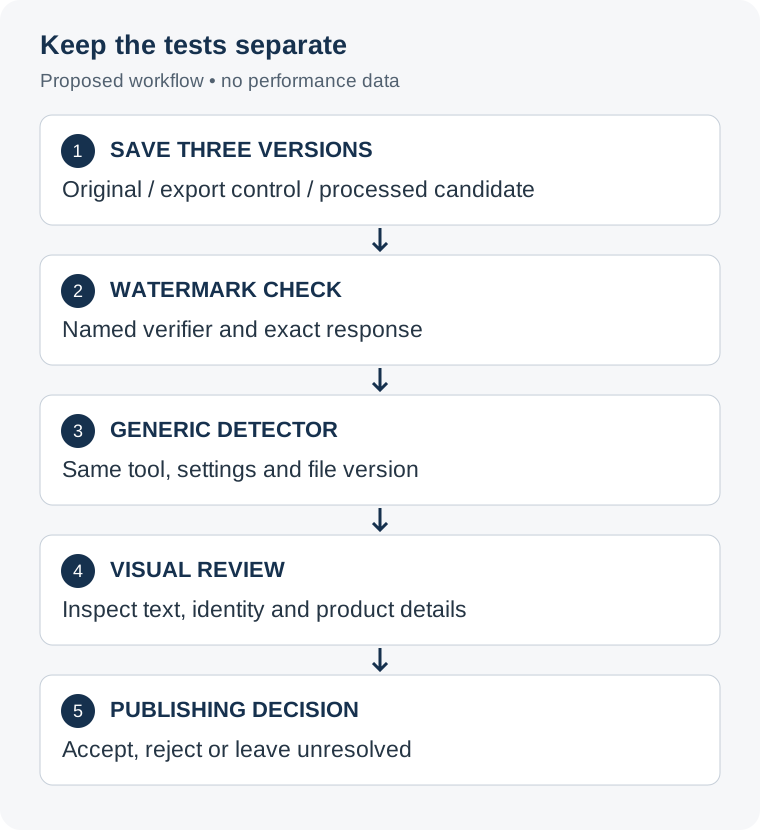
How do you build a useful before-and-after test?
Start with three named versions: the unchanged original, a simple export control and the processed candidate. The control helps reveal whether a result changed during routine encoding rather than because of the processing feature you meant to test. Keep dimensions and format comparable where the tool allows it.
Save the filename, file hash, dimensions, creation source, processing settings and test date. Run the same named verifier on each version. Record an unavailable or inconclusive result exactly that way; do not turn it into “not detected.” If a service exposes a version or threshold, save it too.
For a documented watermark check, sign in to Gemini, upload one version at a time and ask whether it was created or edited by Google AI. Google's verification instructions explain the supported accounts and results. Record the SynthID-specific response separately from any Content Credentials summary or visual assessment. Gemini's documented SynthID check currently covers Google AI content; it is not a universal verifier for every generator. Respect the available quota and record any check you could not complete.
Use several types of image from your real workload, including ones with fine text or detail. Keep camera originals with a known history as controls for generic detector false positives. These are proposed test-design choices, not a sample we ran for this article.
A repeatable record lets another person find the same file and understand the comparison. Without it, a detector screenshot can be accidentally paired with the wrong export or a later version of the image.
What should the test results table contain?
Use separate columns for separate claims. This blank template is intentionally unscored: it is ready for your observations, not a disguised product benchmark. Add one row for every tested file, including failures and outputs you reject for quality.
| File/version | SynthID verifier result | Generic detector result | Visual review | Decision |
|---|---|---|---|---|
| Original | Record exact response | Name tool and record output | Reference | Keep unchanged |
| Export control | Record exact response | Use same tool and settings | Note encoding changes | Compare with original |
| Processed candidate | Record exact response | Use same tool and settings | Check meaningful details | Accept, reject or unresolved |
If you later summarize results, state the denominator. “Not detected in 8 of 10 successfully verified outputs” says something different from “80% success” when another ten outputs could not be verified. Report those unavailable cases and the quality rejects separately.
Do not calculate an average across unrelated detector percentages. A score from one service may use a different scale or threshold from another. Compare each tool with itself, then explain disagreement rather than hiding it inside a combined number.
Why do AI-image detectors disagree?
Detectors can be trained on different generators, use different thresholds and respond differently to image processing. A score is meaningful within the detector's documented interpretation. It is not automatically the probability that the image is artificial, and it should not be treated as a vote about its creator's honesty.
The AI-GenBench preprint proposes evaluation across historically ordered generative models to test generalization to newer generators. That research design highlights a practical problem: a detector that performed well on earlier images still needs evaluation on the images used today.
When tools disagree, inspect the source history and the exact files first. Then check whether the services describe their training coverage and score interpretation. Record the disagreement. Repeatedly trying transformations until one checker returns the preferred answer can produce a file tailored to that checker without establishing anything broader.
For publishing, the more useful question is whether the asset is accurate and appropriate for the post. Detection results can support that review, but they do not replace it.
Will processing remove Instagram, Threads or TikTok AI labels?
No universal result follows from changing an image file. Platform labels can reflect more than one source of information. Meta's explanation includes shared indicators and self-disclosure. TikTok's announcement describes using Content Credentials for automatic labels.
That means “the metadata inspector is empty” and “the platform will not label this post” are different claims. Processing a copy also does not change the fact that it was generated. Follow the platform's current disclosure requirements and the rules of the community where it will appear.
For creators working across channels, keep the final caption and disclosure decision with the asset. Our Threads operator guide covers the broader publishing context, but no engagement tactic is a substitute for a factual asset description.
If a label appears unexpectedly on a genuine photo, preserve the original and editing history while investigating the platform's available review process. Do not assume that another round of image processing will correct a decision whose source you have not identified.
When should you stop processing and use another image?
Stop when the next edit is likely to damage something the audience needs to trust or read. That can be a product label, a person's identity, a chart annotation or a recognizable location. A lower detector score is not worth a false product depiction or a broken tutorial screenshot.
A real capture may be the better source for a demonstration. A simple diagram may be better for an explanation. An openly synthetic illustration may be the right creative choice when it is clearly framed as such. Choose the asset that does the communication job with the fewest unresolved assumptions.
For channel visuals, our Twitch promotion guide covers how imagery fits a wider creator presence. The same practical rule applies: an image should support the content, not become a technical project that distracts from it.
Keep the rejected outputs too while the test is being reviewed. They reveal where a processing mode does not fit your workload and prevent a later person from repeating the same unsuccessful trial.
What can you honestly say after a successful test?
Use a statement tied to the observation: “This verifier did not detect SynthID in this exported file on this date.” If the generic detector also changed its result, report that separately. If the image passed your visual review, name the checks. None of those statements requires pretending the file is a camera original.
For a batch, give the counts, source-image types, tested settings, unresolved checks and quality failures. Keep the unchanged files available to the reviewer. That is the difference between a useful evaluation and a collection of favorable screenshots.
A tool such as Deprint belongs in this workflow when its available processing options match the changes you are willing to make. Its value for your use case should come from the files you can inspect and the results you can reproduce.
Method note: this guide combines primary technical documentation, platform explanations and a detection-research preprint. The tables and diagram are original testing aids. We did not run a Deprint success-rate benchmark or verify that processing changes platform labeling or distribution.
Questions that change the test
What if SynthID is not detected in the original?
You cannot demonstrate a detected-to-not-detected change for that file. Keep the original result and report the watermark-removal question as unmeasured for this pair. You can still inspect metadata, visual quality and generic detector results, but those observations answer different questions.
Can I upload several test images as one collage?
Use separate files. Google's Gemini verification instructions specify one file at a time and advise against a collage of distinct images. A combined image changes the test input and makes it harder to associate the response with a particular original or processed output.
Should I upload a confidential client image to a checker?
Confirm that the client permits that service and that its handling of uploaded files fits the project. Use approved test images while resolving that question. A tool being available without payment does not establish permission to send a client's unreleased product, portrait or campaign asset to it.
:::